E-commerce 360° / Bespoke Shopify stores
Bespoke Shopify stores, built to convert.
A store designed from the brand outwards and engineered from the data upwards. I build custom Shopify themes where product pages, navigation, content and checkout work as one system, so you control what customers see, and what they buy.

E-commerce 360°
One view of the whole store.
Brand, product data, navigation, content and performance are usually handled by different people and different apps. I treat them as one architecture, so every decision on the storefront is connected to how the store sells.
- 01
Brand experience
Typography, imagery and interaction designed for your brand, not adapted from a template.
- 02
Product data
A structured model for every product, variant and story, managed in Shopify admin.
- 03
Customer journey
Navigation, collections, search and cart shaped around how your customers actually decide.
- 04
Performance
Native Liquid and lean code instead of stacked apps, measured and refined after launch.
Two ways in
Build from scratch, or redesign the store you already have.
Some stores need a new build. Others need better structure, faster pages and product pages that sell, on the store that already exists. I work both ways, and the route depends on what the store already holds.
01 / New build
Built from scratch, with nothing inherited
New brands, new stores, or an existing store that has outgrown its data model.
- A theme written for your products, brand and customers, with nothing copied from a template.
- Data model, navigation and page templates planned before design begins.
- Lean code from day one: no stacked apps, no unused sections, no leftovers to maintain.
- Hosted on Shopify, so payments, tax, shipping and inventory stay where they belong.
02 / Redesign
Customised and redesigned on your existing store
Established stores with sales history, data and traffic worth protecting.
- Design, product pages, navigation and search rebuilt on the store you already run.
- Products, variants, metafields, customers, orders and URL handles carried over intact.
- Redirects, structured data and Search & Discovery settings preserved, so rankings and traffic hold.
- Work built on a staged preview theme and switched only once QA is complete.
Data safety
Your data is the asset. Nothing moves without a plan.
A redesign touches the records a business runs on. Everything is mapped, backed up and checked before anything is changed, and the store keeps trading throughout.
- 01
Backed up first
Products, customers, orders, themes and content exported before work begins.
- 02
Mapped, not guessed
Metafields, metaobjects, collections and tags documented, so nothing is renamed or dropped by accident.
- 03
Staged, then switched
The rebuild runs on a preview theme. The live store is untouched until the new version is approved.
- 04
Verified after launch
Checkout, orders, filters, redirects, structured data and analytics checked against the pre-launch baseline.
Custom code from scratch
Written for your store. Not adapted from a template.
Template themes and stacked apps are built for every store at once, so they carry code for features you never use and still miss the ones you need. A bespoke Shopify theme is written for your products, your brand and your customers, and nothing else.
The result is a store that loads faster, breaks less and costs less to run: features that would otherwise mean monthly app subscriptions are built once, into the theme, and owned by you.
- 01
Shopify Online Store 2.0 & Liquid
A custom theme built on JSON templates, sections and blocks, so your team can compose pages in the theme editor without touching code.
- 02
Custom sections & interactions
Product configurators, sizing calculators, bundle builders, cart drawers and editorial layouts designed and coded for how you sell.
- 03
Fewer apps, lighter pages
Functionality replaced in native Liquid and lean JavaScript, reducing third-party scripts, layout shift and recurring app costs.
- 04
Core Web Vitals
Responsive images, lazy loading, critical CSS and minimal render-blocking code, measured against LCP, INP and CLS on real mobile devices.
- 05
Accessible, semantic markup
Keyboard navigation, focus states, alt text and heading structure built in, which also helps search engines read the page.
- 06
Version control & handover
Code kept in Git with staged theme previews, documented sections and a clean handover, so the store stays maintainable.
Product pages
Product pages that convert.
The product page is where the sale is won or lost. Each element earns its place by answering a question the customer has before buying.
- 01
Hierarchy
Name, price, key benefit and the buy button read in the first glance, on every screen size.
- 02
Variants that make sense
Colour, size and material presented visually, with stock, delivery and price updating instantly.
- 03
Reassurance
Materials, care, sizing, delivery and returns placed exactly where doubt appears.
- 04
Storytelling
Provenance, craft and lifestyle imagery that justify the price without slowing the page.
- 05
Cross-sell
Sets, bundles and complementary products driven by data you control, not generic recommendations.
Product-page architecture / Client work
In practice: a live storefront.
Buying options, measurement guidance and personal help, connected by one data model. A real storefront product page, designed and built for Di Maggiore.
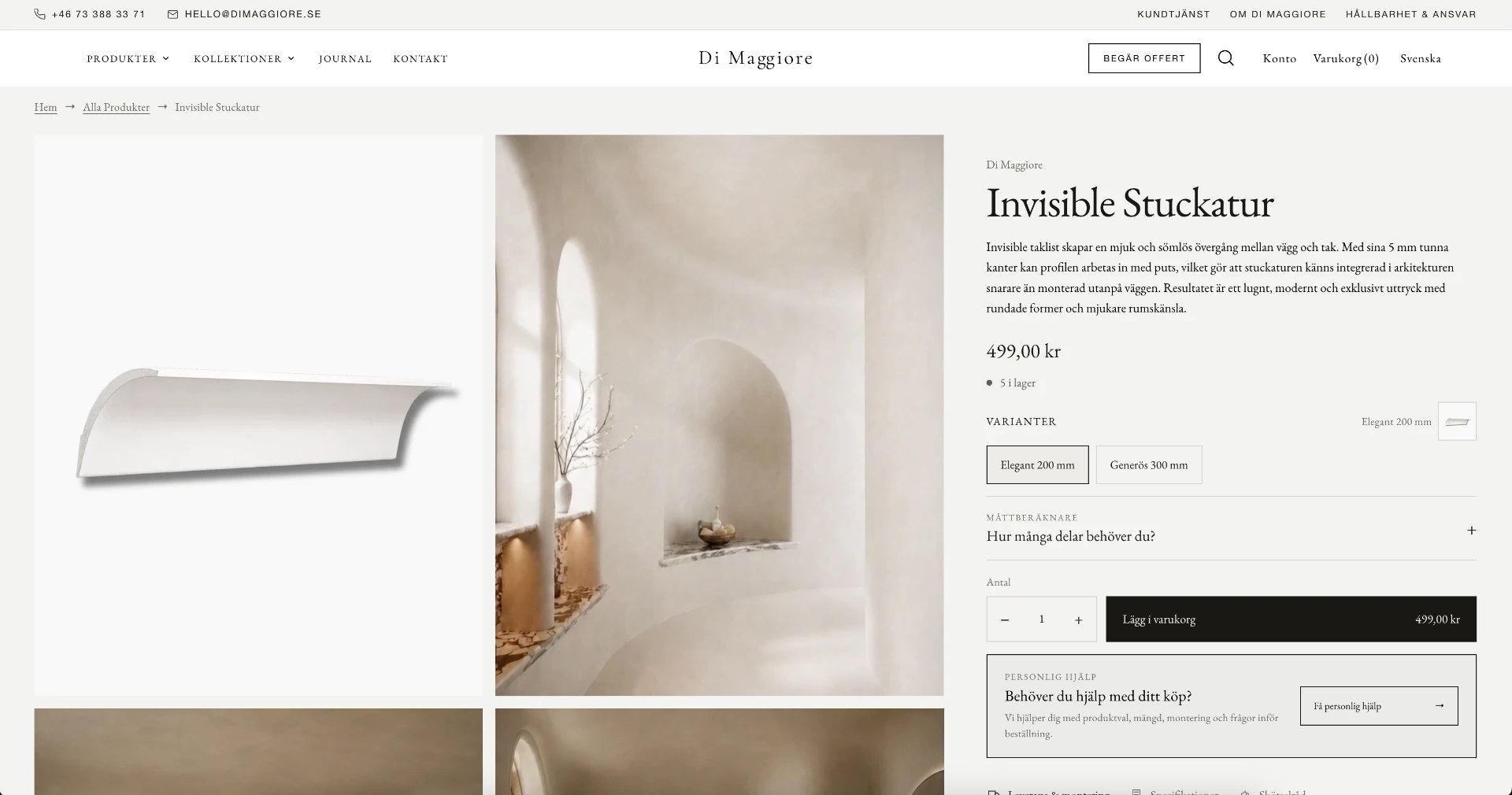
Sizing doubt, removed
A measurement calculator with installation allowance turns metres into exact pieces before hesitation sets in.
Options without dead ends
Variants, stock and specifications live in structured product data: metafields and metaobjects, not buried in copy.
Help with context
The personal-help enquiry carries the product with it, so the conversation starts warm instead of from zero.
Metafields & metaobjects
Take control of your store data.
Metafields and metaobjects turn Shopify into a structured content system. Your team edits specifications, materials, designers or size guides once in admin, and they appear consistently across product pages, collections, filters and search.
Metafields
Custom fields on products, variants and collections: specifications, care, dimensions, ingredients, badges.
Metaobjects
Reusable entries such as materials, designers, collections stories or size charts, linked to many products.
Filters & search
The same data powers Search & Discovery filters and structured data for Google and AI search.
No code edits
Sections read from the data, so new products and campaigns launch without a developer.
- product.material
- → Metaobject: Material
- material.name
- Recycled 18k gold
- material.care
- Rich text, shown on PDP
- product.size_guide
- → Metaobject: Size chart
- product.pairs_with
- → Product list
Planned navigation & customer journey
Navigation that leads somewhere.
Most stores grow menus by accident. I plan collections, menus, filters and internal links as one information architecture before design begins, so customers move from inspiration to product to checkout without dead ends, and search engines understand the structure.
- 01
Collection architecture
A clear hierarchy of categories, sub-collections and curated edits, based on how customers search and compare, not on internal product codes.
- 02
Mega menu & mobile menu
Menus designed for thumb and cursor alike, with imagery, featured collections and the shortest route to bestsellers.
- 03
Internal linking & breadcrumbs
Related collections, breadcrumbs and cross-links that guide customers deeper and distribute authority across the store.
- 04
Clean URL structure
Canonical product URLs and consistent handles, so collections do not create duplicate pages.
- 01
Discover
- 02
Browse
- 03
Compare
- 04
Decide
- 05
Buy
- 06
Return
On-site Search & Discovery
Help customers find the right product, faster.
Customers who use on-site search are often the closest to buying. I configure Shopify Search & Discovery and build the storefront around it, driven by the same metafields that power your product pages.
Filters & facets
Filters by material, colour, size, price or any metafield, ordered by what matters most in each collection.
Predictive search
Instant suggestions for products, collections and pages as the customer types, designed to match the brand.
Synonyms & boosts
Search terms mapped to how customers actually describe products, with key items boosted for priority queries.
Recommendations
Related and complementary products configured on product pages and in the cart to raise average order value.
Zero-result recovery
Empty searches reviewed and redirected to relevant collections instead of dead ends.
Conversion optimisation
Measured, then refined.
Analytics foundation
Clean events from view to purchase, so decisions rest on real behaviour.
Speed
Lightweight templates and fewer apps for faster pages, especially on mobile.
Testing
Hypotheses on product pages, collections and cart tested and rolled out step by step.
How a build runs
- 01
Audit & strategy
Store, data, analytics and customer journey reviewed against your goals.
- 02
Architecture
Data model, navigation map and page templates defined before design.
- 03
Design & build
Custom theme in Liquid, built section by section and editable in Shopify.
- 04
Launch & optimise
Migration, QA, launch and ongoing conversion work.
Ready to build a store you fully control?
Discuss a bespoke storeFAQ
Questions we are often asked
Contact
Planning a bespoke Shopify store?
Tell us about your products, your current store and what needs to change.